After 106 years there is still no Equal Rights Amendment
 Women’s Equality Day is August 26th marking 106 years of women having the right to vote in America. Despite this huge win for women, did you know that the United States of America does not have an Equal Rights Amendment for women?
The original Equal Rights Amendment was sent to Congress in 1923, 103 years ago! But in those 103 years, it still has not become a part of America’s Constitution.
Many of you probably remember the ERA YES “Bra Burning” protests in the 1960s and early 1970s in regards specifically to the ERA and many of you may remember that it passed Congress in 1972, but did you recall that the states never ratified it? The amendment came up just three votes short of being ratified. Some of the states that chose not to ratify were surprising. Arizona and Nevada both did not ratify the amendment and they have been considered to be forward thinking states in the 1970s at the time of the ratification votes.
Other states that did not ratify the ERA were mostly in the south, Alabama, Arkansas, Florida, Georgia, Illinois, Louisiana, Mississippi, Missouri, North Carolina, Oklahoma, South Carolina, Utah, and Virginia. Since the ERA’s failure to be ratified, the Equal Rights Amendment was reintroduced in Congress on July 14, 1982 and has been before every session of Congress since that time.
The ERA was reintroduced as S.J. RES. 10 by Senator Robert Menendez on March 5, 2013 but was again stalled. As of 2026, there are lawmakers in the 119th Congress that are pursuing a game plan for finishing ERA ratification without starting the whole amendment process over from scratch. (Source: FlagandBanner.com’s exclusive Women’s Equality Day educational poster.)
Why is the amendment so radical?
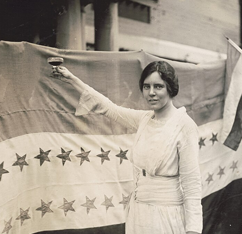
The text of the Amendment is short and to the point and is not inflammatory in any way yet, it fails year after year to become the law of the land. The Amendment was written by Alice Paul, a women's rights activist of the 1920s. Her work along with many other women of the time is why the 19th Amendment passed, but even with that victory, Paul felt there was more that could be done to protect women. So she wrote and advocated for the Equal Rights Amendment.
Here is the text:
- Section 1. Equality of rights under the law shall not be denied or abridged by the United States or by any state on account of sex.
- Section 2. The Congress shall have the power to enforce, by appropriate legislation, the provisions of this article.
- Section 3. This amendment shall take effect two years after the date of ratification.
Why wouldn’t states ratify the ERA?
Some may feel that the Equal Rights Amendment is not needed since women won the right to vote with the passage of the 19th Amendment in 1920 and women of African or Asian background secured the right to vote in 1948. Then in 1963, President Kennedy signed the Equal Pay Act and in 1964 the Civil Rights Act all laws that would protect women’s rights. The Voting Rights Act of 1965 is another Act that prohibits states and local governments from imposing any prerequisite to voting. And in 1978, Congress passed the Pregnancy Discrimination Act as an amendment to the Civil Rights Act of 1964, protecting women from discrimination based on pregnancy.
The argument against ratification may be that many believe these other laws and Acts “cover” women from discrimination based on sex. Though that isn’t a correct assumption, these Acts are very specific and unlike a Constitutional Amendment they can be very easily changed, ignored or inconsistently interpreted.
Laws against sex discrimination do not rest on a strong constitutional foundation and this is why supporters of the Equal Rights Amendment say it is needed. The ERA would place the burden of proving discrimination in a court of law on those who discriminate not the victim of discrimination as it is now.
“Sex discrimination is so 1960, this is 2013 (see 2026 update below)!
American’s may think, “This is 2013 women aren’t discriminated against anymore.” Unfortunately, the statistics do not back that statement. Women are still paid significantly less than men even with the Equal Pay Act on the books.
Senior women find themselves collecting much less Social Security wages as well due to the policies not being updated since the 1940s when only 14% of women were in the workforce and divorce rates were much lower. Today, 58.9% of women are in the workforce. Despite these changes, the Social Security system holds to the same sex-biased assumptions from 1940. Married men receive 100% of their benefits for a lifetime, and since homemakers' contributions to marriage partnerships are not valued fully, wives are considered dependents and as such, receive lower payments. Widows receive only 72% of their deceased husband's benefits, and divorced women receive only half.
Because of this discrimination in the Social Security system, 75% of retired single (either by divorce or due to being a widow) elderly women are living at or near poverty level.
Other forms of sex discrimination happen and women do not even realize it. Insurance for example is drastically different for men than it is for women. Insurance regulators routinely approve the use of selective classifications by sex for premiums and payouts on auto, disability, medical and pensions. Women have been proven to be required to pay higher insurance premiums than men for the same benefits. The excuse for this discrimination is that insurance company tables show that more women than men live longer than average or have higher health costs. Passage of the Equal Rights Amendment would force equality in insurance prices, coverage and benefits. According to the National Organization for Women $2.5 billion dollars a year would be gained by women.
In her own words: What a female entrepreneur has to say
2026 Update: Were the Equal Rights Amendment Stands Today
It's been over a decade since this article was first written, and women are still waiting.
Here's what's changed since then: the ERA actually got its 38th state. In January 2020, Virginia became the final state needed to reach the three-fourths threshold required to ratify a constitutional amendment, joining Illinois (2018) and Nevada (2017) in the final push. On paper, that meets the bar set by Article V of the Constitution.
But meeting the bar hasn't been enough. Three of those 38 states ratified after a 1982 deadline Congress had attached to the amendment, and five states that ratified back in the 1970s later tried to rescind their votes. The Archivist of the United States, whose job is to formally publish a ratified amendment into the Constitution, has refused to do so, citing Department of Justice legal opinions that say the deadline is still valid and that only Congress or the courts can extend or remove it.
In January 2025, President Biden declared that the ERA had "cleared all necessary hurdles" and was, in his words, the law of the land as the 28th Amendment. It was a symbolic statement; Biden stopped short of ordering the Archivist to publish it, and the Archivist has not done so. So even now, the ERA sits in a strange limbo: ratified by enough states to meet the constitutional requirement, but not yet officially part of the Constitution.
The fight has since moved to the courts and back to Congress. Two federal lawsuits, Valame v. Trump and Equal Means Equal v. Trump, are currently arguing that the ERA is already the 28th Amendment and should be treated as binding law, particularly on questions like whether the all-male military draft is constitutional. In Congress, the 119th session (2025–2026) has seen renewed bipartisan effort with the "three-state strategy" bills — S.J. Res. 38, led by Senator Lisa Murkowski (R-AK), and H.J. Res. 80, led by Representative Ayanna Pressley (D-MA) — both aiming to affirm that the ERA is validly ratified.
So, 100-plus years after Alice Paul first wrote it, and more than 50 years after it passed Congress, the Equal Rights Amendment still isn't printed on the same page as the rest of the Constitution. The states did their part. Now it's a question of whether Washington will finish the job.
(Sources: Congress.gov, National Archives, Equal Rights Amendment Coalition, National Constitution Center. Current as of August 2026.)
FlagandBanner.com is based in Little Rock, Ark., and has been in business since 1975. They have been selling flags, flagpoles, banners, pennants and home and garden décor online nationally since 1995.
For more information about the more than 22,000 products Arkansas’s FlagandBanner.com offers, log on to FlagandBanner.com. Follow FlagandBanner.com on Facebook, or call one of their experts at 1-800-445-0653.